
Big Rocks

rocky beach during sunrise
Photo by Quang Nguyen Vinh on Pexels.com

“Things which matter most must never be at the mercy of things which matter least.” 

― Johann Wolfgang von Goethe

The author Steven Covey would frequently challenge audiences with the following task. He would roll out an empty 5 gallon container, along with four smaller containers. One container had water, the next sand, the third had pebbles, and the last one had rocks. Covey asked the audience to place as much material as possible from all of the small containers into the large one. Many people had difficulty coming up with the proper solution; which follows. 

First put the big rocks in, then the pebbles which fall between the rocks, then the sand which falls between the pebbles and finally the water. If you don’t follow this sequence, you will never fit all the materials in.

Of course Covey’s demonstration was not only about filling up a container. He wanted to awaken in people how to create a life full of purpose and meaning. The key is to always put the big rocks in first. The  big rocks represent what is important in your life. When you fail to schedule your big rocks, things that really matter to you never seem to make it to daylight.

Covey suggested that when we plan our day we always schedule our big rocks first, with every thing else being secondary. 

Over the past 20 years I have followed Dr. Covey’s advice. Of course, the first step is to identify the big rocks which add meaning and deep value to your life. No doubt your dentist appointment is important, but does it really add meaning to your being? (That being said, Covey would tell you that if you need an emergency root canal, that constitutes a big rock as well)

Some big rocks in my life include time with family, exercise, meditation, tai chi, writing, blogging, Twelve Step Program and personal development. No matter what is happening in my life, on a daily basis I schedule a few big rocks in my calendar. At day’s end I examine to see if those rocks were tapped into or not. In the event that a big rock was neglected, I plan out a way for it to be more accessible the next day.

There are also big rocks that involve a month’s planning, and some which require a year or more of attention. I recently completed my first book, Insights from the Rooms, which involved four years of big rock designation. 

Don’t get distracted by the pebbles, sand and water in your life. Schedule some boulders right now!

Journaling

desk empty fountain pen notebook
Photo by Lum3n.com on Pexels.com

I have been journaling every day for the last 15 years. No two days of journaling have been the same. There are of course journal purists who say that only our deepest reflections should be placed in our journal. I have a very different point of view. My journaling serves many purposes and continues to evolve.

Over the last few years my journal has acted as a daily reminder to awaken and appreciate my life.  Every day, I list 5 gratitudes, 5 positive things about myself and 5 joys in my life. Each of these is written in consecutive order. That means each category has over three thousand entries. When I see positives, joys or gratitudes numbering in the thousands, the sheer volume of it can help me shake off a temporary setback. Of course certain entries are oft repeated because they continue to have an uplifting affect on my life.

 Even if I write nothing else for that day’s journal entry, this practice initiates a positive trajectory for the rest of the day. What usually happens is that a daily entry touches a chord and I will expand on a gratitude, positive trait or joy in my writings.

I also use my journal for those times when something occurs which knocks me off center. Whenever that happens I reach for my journal and record my thoughts. Initially, my comments are often about how I have been “wronged” or “treated unfairly.” Just being able to vent my feelings helps me to begin to distance myself from the upset. With that distance I begin to gain perspective and am often able to write about how aspects of my behavior were inappropriate. I often conclude with a written commitment to make amends where necessary or to change my behavior in the future.

There will of course be times where my journal entry will be deeply reflective. Often this takes the form of an open ended question regarding some aspect of my life. I will then put my pen down and contemplate that question. What often happens is that after a few minutes answers begin to form in my mind and I resume writing. I really do believe that the answers I receive as part of this process come from a Higher Place.

On a more mundane level my journal is a reservoir of phone numbers, snippets of ideas for articles, creative doodling (zentangle) and anything else which needs to be found at a later date.

Ultimately I journal because I love to write and bring my thoughts into a paper and pen reality.

Journal Writing — Tools Of The Trade

pen writing gold ink
Photo by Pixabay on Pexels.com

“My two fingers on a typewriter have never connected with my brain. My hand on a pen does. A fountain pen of course. Ball point pens are only good for filling out forms on a plane.” —Graham Greene

Like most people in our current society, technology is a major part of my life. My IPhone allows me to listen to music nonstop, practice deep guided meditations, buy and sell stocks and of course speak and text with people. I wrote my book, Insights from the Rooms on my IPad. Ditto for my blog of the same name. I am currently writing this post for Pasta on a Wall using my IPad. 

Yet, on my nightstand you will find a fountain pen and a journal for daily writing. And not any journal mind you. It is manufactured by Clairefontaine, a French paper company started in 1858. It is a 90gsm paper. GSM stands for grams per square meter. The higher the gsm, the thicker the paper. Clairfontaine paper with a 90gsm is a fountain pen friendly paper. That means that when you use a fountain pen it will not “feather” or bleed through to the other side of the page. The paper in my journal is smooth, soft to the touch and substantial.

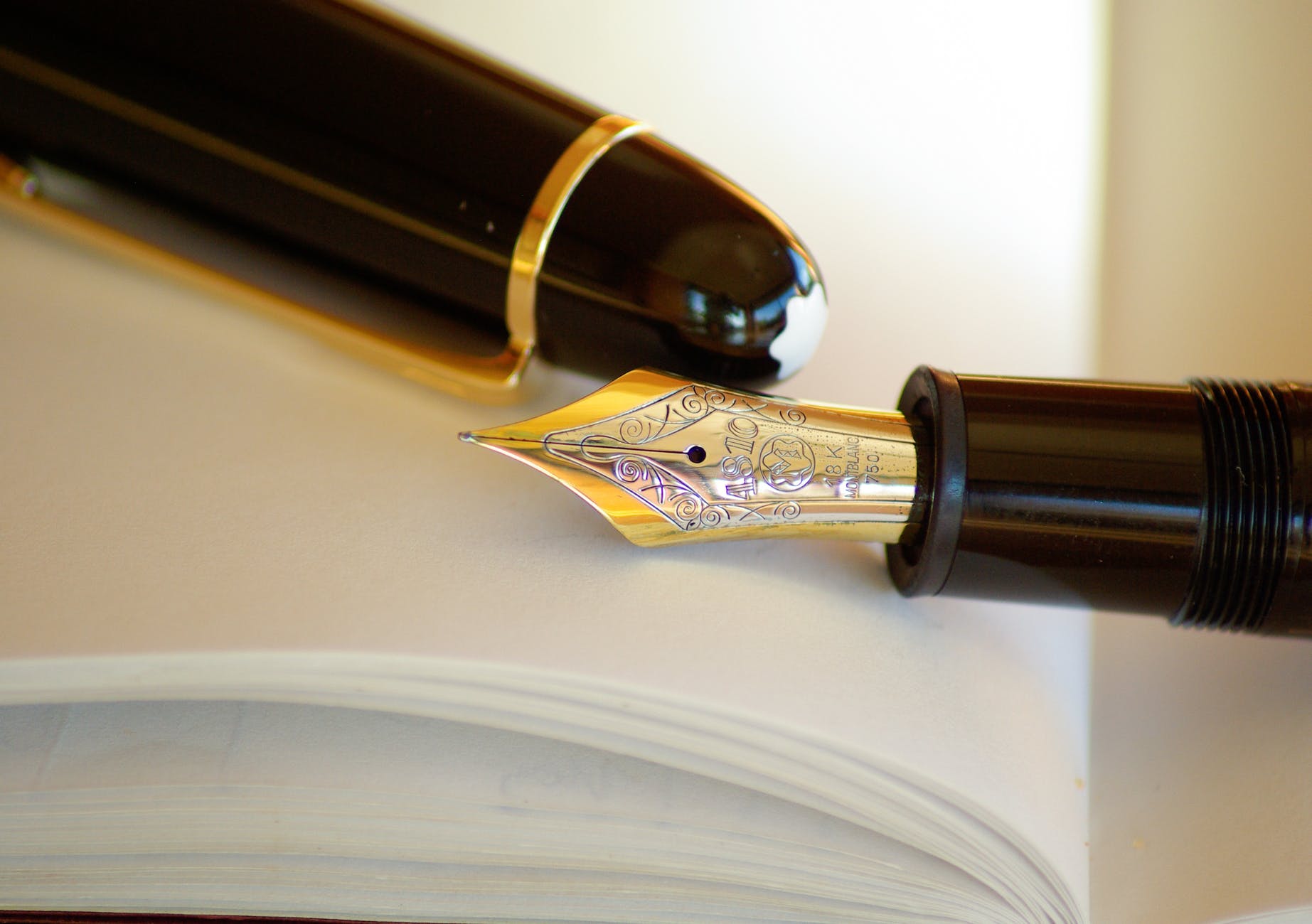
There is probably a good chance that some of you reading this post will have never had the opportunity to use a fountain pen. I guarantee you that it will change how you write forever. First the aesthetics. Fountain pens are beautiful to behold. They come in an inexhaustible choice of materials, patterns, nibs, shapes and sizes. You can spend as little as $3 on a Varsity Pilot disposal fountain pen (a great first pen) to multiple thousands for pens manufactured by companies like Omas, Visconti or Montblanc. Part of the pleasure of fountain pens is choosing one that resonates with you. My current go to pen for journaling is the TWSBI white with rose  gold demonstrator; a pen that allows you to see the ink supply through the body of the pen. And of course there are hundreds of inks to choose from.

There is something magical about writing with a fountain pen. Because of its nature of ink flow, it forces you to slow down your writing. Suddenly you begin to create more beautiful letters and words with an upturned line here and an additional flourish there. Your pen glides across the paper with almost no resistance; causing your thoughts to glide from your mind to your pen without resistance.

On a deeper level I believe utilizing an instrument from the past like a fountain pen taps into the flow of energy of all those who came before and wrote in this manner. The ballpoint pen has little history, while the fountain pen has been used for hundreds of years. 

If you envision squirting ink all over yourself, relax. The fountain pens of today are easy to use and to refill. You can even get them with disposable cartridges. 

Journaling is a highly personal experience. Make it even more so with a thoughtful choice of fountain pen and a high quality journal paper.

A Year of Good Mornings

white cup filled by coffee
Photo by jonas mohamadi on Pexels.com

“All the lonely people
Where do they all come from?
All the lonely people
Where do they all belong?”

Eleanor Rigby — The Beatles

There is an apocryphal story told of a women who worked in a meat packing plant. Towards the end of of her shift she locked herself in a walk-in freezer. She banged and screamed on the door but no one came. Within a short period of time she began to experience hypothermia. After a few hours she had resigned herself to freezing to death. Shortly thereafter the security watchman opened the door of the freezer and she was rescued. While waiting to be taken to the hospital she asked the watchman why he came and opened the freezer door.

He told her that although it was a large company, very few people greeted him in the morning or said goodbye in the evening. She was one of the few who practiced this small amenity. He remembered that she had greeted him that morning; but had no memory of her saying goodnight to him when she left. As a result he became suspicious and went to look for her and in doing so saved her life.

When I heard this story I thought about my own actions. I realized that I rarely said good morning to others. Not only didn’t I greet strangers on the street; I didn’t say good morning to workers in stores I frequented, to people who delivered my mail, to garbage collectors or even to coworkers at my job. More often than not I was so self absorbed in my thoughts that I just walked right past people.

Right then and there I decided to say good morning to whoever I met during the morning hours for one year.

No, I wasn’t hedging my bets about being locked in a freezer. It was more about my belief that as human beings we are all deeply connected. Except for recent history, we were tribal in nature and very much entwined in each other’s lives. 

Once I began the practice, I  found that in the vast majority of cases people responded with a reply of good morning and a smile. There was a slight but perceptible relaxation of their muscles and a slowing of their gait. It was as if to say, “Oh, another member of the tribe, let me show him we are connected.”

I also found that the more good mornings I uttered, the better I felt. I don’t have any scientific proof that saying good morning helps our emotional state. I’m sure one day neuroscientists will get around to placing people in MRI machines and then piping in a series of “good mornings” to see the affect on mood. 

In the meantime I will just continue to say good morning to people. I’ve been doing it for over 10 years now and it has become one of my morning rituals. 

The Power of Books

assorted books on shelf
Photo by Element5 Digital on Pexels.com

“In the case of good books, the point is not to see how many of them you get through, but rather how many can get through to you.” —Mortimer J. Adler

Every so often, we read a book which “gets through” to us. It’s the book that we begin to underline passages that have meaning for us. The one that has our little notes in the margins making short observations about what we’ve read. The one that we start quoting from when we’re engaged in a deep conversation with someone.

This will be the first of a number of entries about books which created change in my life. My first choice for my booklist is Big Magic by Elizabeth Gilbert. It is a book about creativity. 

As she points out all of us have that “aha moment” for a book, a painting, a song, a new business venture or a myriad number of other creative ventures. We feel energized and excited about this newfound opportunity. And then as so often happens we keep pushing it off or delay our start date.

Then one day to our dismay we discover that someone else has written that book, painted that painting or started “our” business venture. What happened? Ms. Gilbert believes that initial inspiration of creativity comes from a Higher Place. Its visit to you is a gift. But, it doesn’t stick around forever. When you don’t follow up, it lingers for a period of time and then lands at someone else’s doorstep. When they grasp it and run with it a new creative idea or object enters the universe. You lost your claim to it.

In my life I have been graced with a number of creative moments which I neglected. Then I read Big Magic. At about the same time I had the idea to write about the Twelve Step Program. Instead of going back to a state of sleep, I decided to blog about it. Mind you I had never blogged before. That very day I started my blog, Insights from the Rooms (insightsfromtherooms.com). Then, the idea popped into my head to blog every single day without fail for a year. I honored that commitment which in retrospect amazes me that I was able to do so. Along the way I had thousands of hits on my blog from all over the world.

After a few years of blogging, I was graced with another creative moment and decided to turn my blog posts into a book. Though there was initially some inertia over this I finally did commit to an editor, then a book designer and finally a publisher. In April of 2019, my book Insights from the Rooms was released (https://www.amazon.com/dp/173299420X/ref=cm_sw_em_r_mt_dp_U_3FU-CbHYDS191).

That my friends is Big Magic